
Aerostructural design optimization of truss-braced wing
Postdoc project, 2025
Overview
A truss-braced wing is ultra-high aspect ratio wing with truss-braced structure. Its very high aspect ratio significantly reduces the induced drag, hence the fuel burn, while the truss-braced structure would alleviate the structural weight penalty. Understanding the trade-offs between aerodynamic performance and structural weight penalty is crucial to evaluate the viability of the truss-braced wings for future aircraft.
We investigated the conceptual design space of truss-braced wings using low-order, rapid aerostructural analysis and optimization using OpenAeroStruct. OpenAeroStruct coupled the vortex lattice method for aerodynamics and 1D beam finite element model for structure. We expended OpenAeroStruct’s capability to model composite truss-braced wing, while also coupling OpenAeroStruct to OpenConcept’s mission analysis and aircraft-level sizing models.
The following figure shows an example of aerostructural solution at a pull-up maneuver condition; the left hand side shows the aerodynamic loading distribution, and the right hand side shows the stress and local buckling metrics. 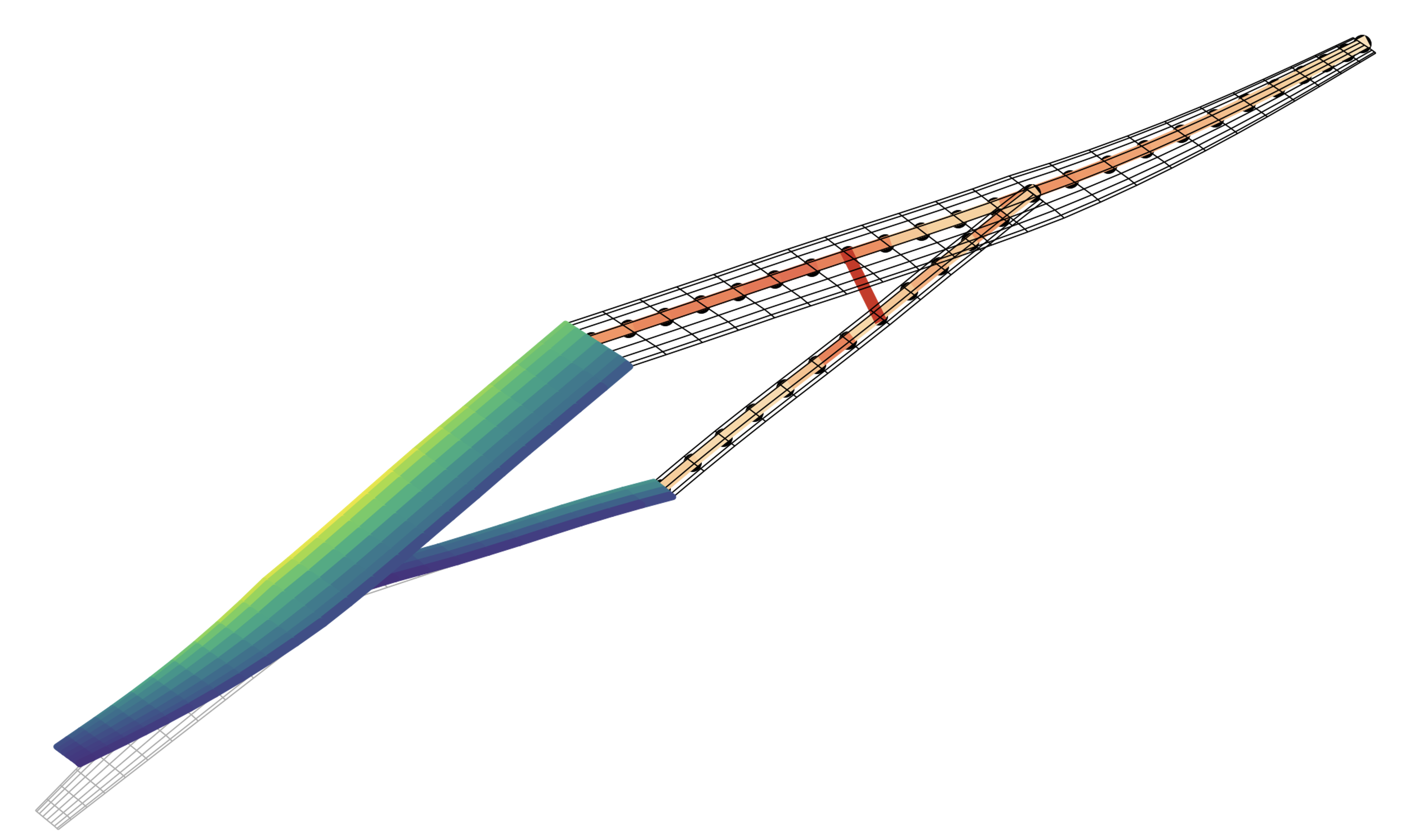
Using these tools and the new aerostructural model, we compared the drag, fuel burn, and weight of truss-braced wings and conventional cantilever wings, both at wing-only and aircraft-sizing levels.